
What to know
- OpenAI announced Grid Protectors as a program to negotiate demand reduction for future compute campuses during grid stress.
- The company says a planned Georgia campus agreement includes up to 1,000 MW of demand response; this is a stated commitment, not measured delivered curtailment.
- OpenAI says flexible demand complements rather than replaces new power supply and transmission investment.
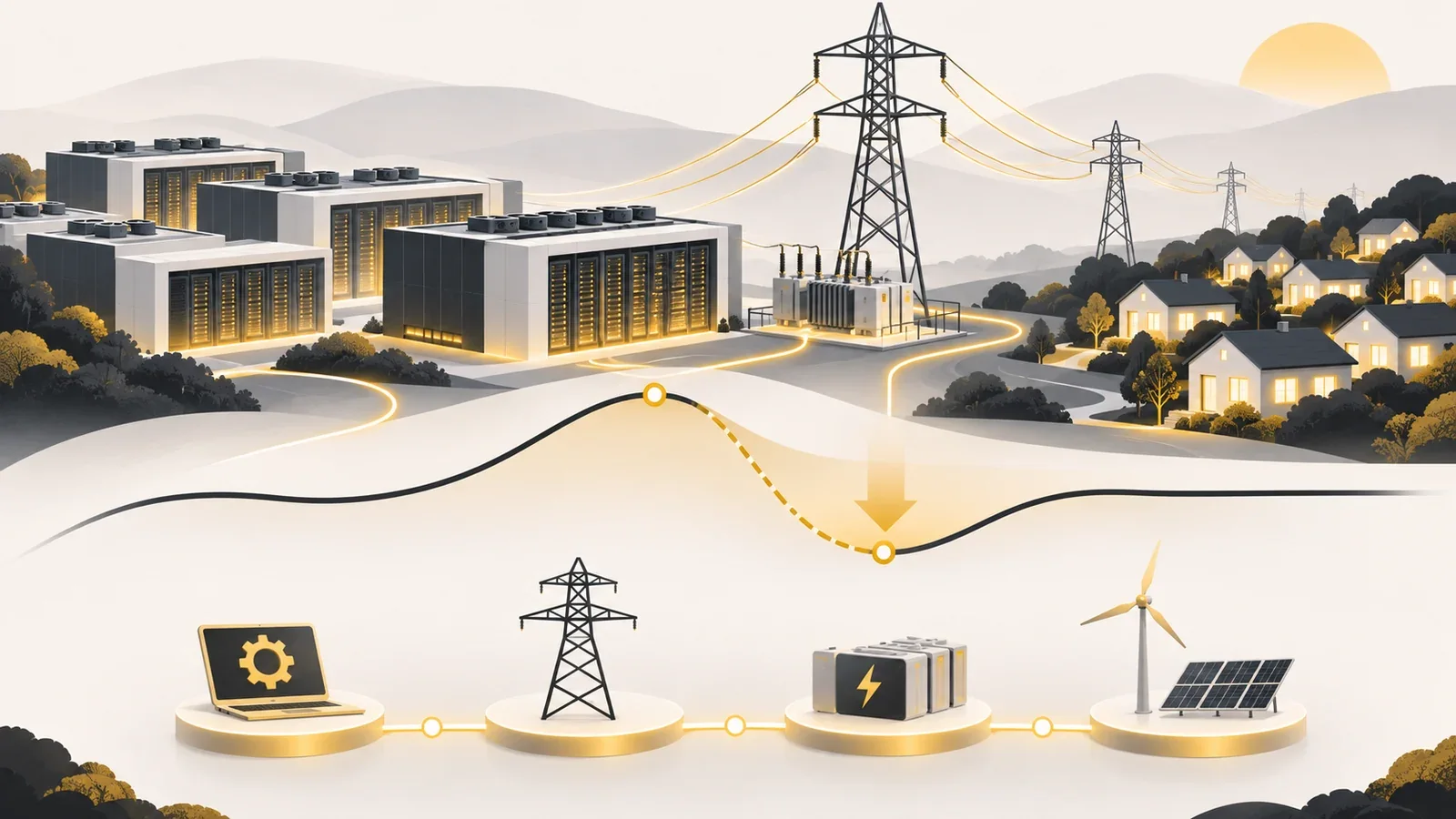
Direct answer: OpenAI announced Grid Protectors on 2 November as a program to arrange demand reductions at future compute campuses when local electricity systems are under strain. Its post describes a planned Georgia campus and an agreement that includes up to 1,000 megawatts of flexible demand response. The announcement does not show that this amount has already been delivered in a real grid emergency.
What the program says campuses may do
OpenAI says it will work with utilities, regulators and policymakers on arrangements that specify how much demand a campus can reduce, how quickly, and for how long. Depending on the location and equipment, the company also describes on-site generation or storage, batteries and power controls as possible parts of a response. These details matter because “flexibility” is not one universal technology. A data center may shift some workloads, use stored energy or adjust cooling and compute schedules, but the practical options depend on technical design and local grid rules.
For its planned Effingham County campus in Georgia, OpenAI says it has committed to pay the full infrastructure and electric-service costs required for the project. It describes up to 1,000 MW of demand response in its agreement with Georgia Power. The campus is still in development, so readers should treat these as stated commitments and planned arrangements, not as measured operating results. The company’s post also attributes a projected $950 million in annual customer savings beginning in 2029 to Georgia Power’s broader portfolio of large-load agreements and expected growth, rather than to this single program alone.
Why demand response is not the whole grid plan
Large compute loads can arrive at a time when utilities need to build generation, transmission and local distribution capacity. Reducing consumption during a constrained period may help manage peaks, but it cannot by itself create the energy needed across all seasons and hours. OpenAI explicitly says flexibility cannot replace investment in new supply and transmission. That qualification is central to interpreting the launch: Grid Protectors is presented as one demand-side mechanism alongside infrastructure expansion.
Potential benefits to other customers depend on agreement design and actual performance. Questions include how a reduction is measured, whether it is available during the grid’s most difficult conditions, how long it can be sustained, what backup power emits, and who bears costs if a project is delayed or curtailed. OpenAI says future contracts and financial assurances can protect other customers if a project changes, but the release does not provide the complete contract terms or independent performance data.
Evidence that would make the commitments testable
As the project develops, useful public evidence would include the campus’s operating date, the specific load that can be curtailed, utility dispatch records, duration and notice requirements, and how costs are allocated. A projection of household-equivalent capacity or customer savings is not the same as verified household benefit. Those figures need the assumptions, comparison baseline and portfolio scope to be clear.
The broader technology question is how quickly new compute demand can be connected without shifting project costs onto local ratepayers or compromising reliability. The announcement sets out a proposed approach and an early agreement; it does not settle that question. Readers can evaluate progress by comparing promised flexibility with published grid data and contract outcomes as the campus moves from planning to operation.
AI-assisted editorial preparation and an AI-generated illustration were used. Claims are attributed to the linked sources; corrections may be submitted through BijliCoin’s contact page.
Sources
- OpenAI: Introducing the Grid Protectors Program (2 November 2026)
Editorial note: AI-assisted editorial preparation and an AI-generated illustration were used. Claims are attributed to the linked sources; corrections may be submitted through BijliCoin’s contact page.
Sources & context
See our editorial policy or report a correction.
Related guides and definitions
- A database backup needs a restore rehearsal to become useful evidence
A practical guide to defining recoverable data, rehearsing restoration safely and distinguishing a backup file from a recovery capability.
- Make a publication faster without breaking the reading path
A practical performance review for article sites that treats reading, forms and accessibility as outcomes to preserve.
- What is a software supply chain?
A software supply chain includes the people, components, tools and delivery processes that turn source inputs into the application users actually run.
Join the conversation.
Loading reader discussion…
Sign in to like this article or add a comment. Comments are reviewed before appearing publicly.
Open the sign-in link in this same browser. Your display name is public; your email is private. Reader sign-in does not subscribe you to the newsletter. See our privacy notice.
Signed in as